
When software businesses with a traditional outbound sales model stagnate or are struggling to reach profitability, they often look to transition to a product-led growth (PLG) strategy.
They hope PLG is their saviour.
They expect that such a transition is the right strategy to re-ignite growth and reach profitability fast. More than once I’ve heard founders say “ The sales team is ineffective and expensive, and yet the product is so good it should sell on its own…”.
Is it as simple as firing the sales team, creating a landing page with a self-serve model and hoping for the best? Not quite.
In simple terms, in a product-led growth strategy, the product itself is the primary driver of acquisition, retention, and expansion. In a sales-led growth strategy, sales teams play a central role in acquiring and retaining customers.
Wes Bush summarized a key difference between the two models in the following graph:
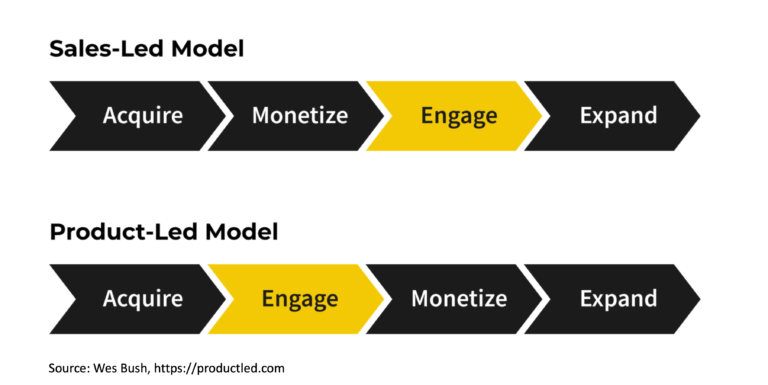
In a product-led growth model, the engagement with the product happens before the monetization step. This brings some fundamental differences in how you go to market, how potential customers experience the product and how you organise your internal teams.
With the PLG model, the entire marketing, sales and product design process is focused on encouraging the customer to engage with the product and extract value before the monetization process. As Wes perfectly puts it” In a successful product-led business, monetization is the natural result of engagement because customers are solving a costly pain point with your product and can’t imagine going back to life without it.”
Before transitioning to a PLG go-to-market model there are a few economic and market realities to consider. While both strategies have their merits, the choice between product-led growth and sales-led growth often depends on factors such as the nature of the product, target market, competitive landscape, and available resources. In particular:
-
- If you serve a sector with long sales cycles, high cost and high touch, then a PLG will not work
-
- complex products requiring extensive, training, implementations and support will not be suitable for PLG. The value creation of using the product needs to happen fast for a successful PLG
-
- even if PLG strategy works as the main growth diver at the earlier stages of the business, the effects of inbound marketing and referrals will eventually ease off and need to be complemented with proactive sales outreach targeting larger enterprise accounts
-
- average contract values lower than $10k will make it financially difficult to adopt SLG
-
- an easy definable and large addressable market makes PLG possible. A small addressable market with complex needs requires an SLG.
I’m a big advocate of the principles of PLG. But despite its effectiveness, PLG alone may not fully harness the potential of a company’s sales efforts. While each strategy has its merits, savvy businesses are discovering the potential for exponential growth lies in combining elements of both – enter the product-led sales strategy (PLS).
This strategy leverages the strengths of the product itself to drive sales while still incorporating sales efforts to enhance customer acquisition and retention.
With the PLS you use the product as the primary sales driver. The product itself becomes the main touchpoint for collecting valuable data that informs iterative marketing and sales strategies.
In essence: acquire prospects efficiently through self-serve (freemium/trial) and convert them into paying customers through a sales-led approach.
Harsh Jawharker from Openview Partners wrote an excellent article about this PLS go-to-market approach.
Wes Bush at ProductLed and Dirk Sahlmer in his related newsletter have also provided very valuable and actionable insights into this topic. Well worth reading their work for any SaaS business which wants to reignite growth and reach profitability levels faster.