
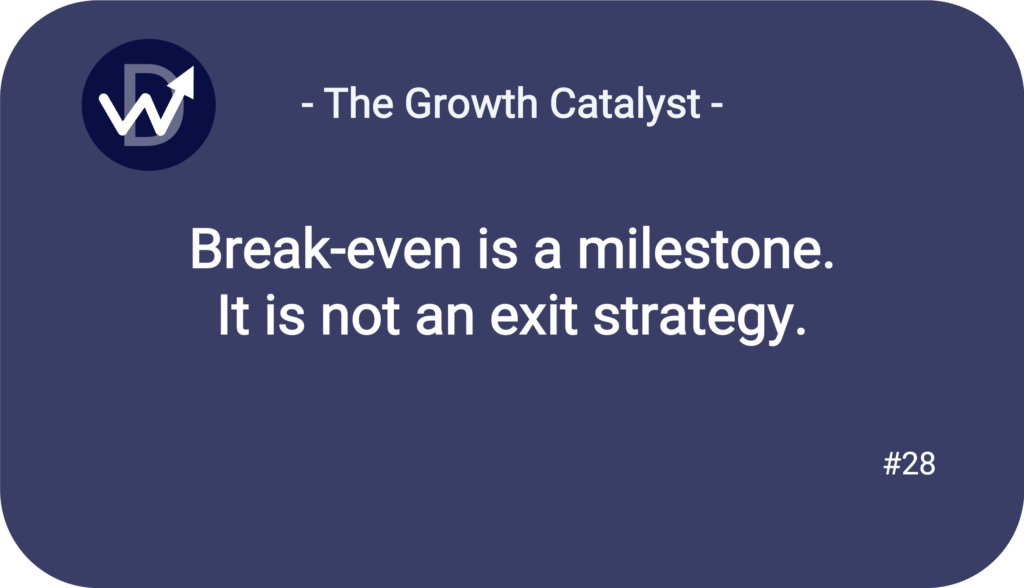
“As soon as we break even, buyers will knock on our doors. As the founder and CEO, I do not have the time to run an M&A process as revenue growth depends on me. So the best bet for a successful exit is if I focus on bringing in more revenue until we break even. At that stage, we won’t need any advisors, as we will get an influx of interested buyers.”
All too often, I heard this version of thinking from founders when we discussed an exit they’ve been hoping for over several years.
And while it sounds intuitive, there is quite a lot to unpack.
Let’s break it down.
1. “As soon as we break even, we can go to market”
Yes, profitability helps, but what matters is not a single break-even moment. It’s whether profitability is sustainable, repeatable, and credible. Buyers don’t pay for a moment in time, they pay for confidence in the future.
Everything is possible in the M&A world but realistically, you would need to have very high annual revenue growth rates at 30%-40% and show a path to profitability to put yourself in a position for M&A discussions when you are still unprofitable.
Even after reaching break-even, buyers will expect to see that it is systemic, not the result of short-term adjustments. A couple of years of consistent performance, backed by credible forward projections, carries far more weight than a single milestone.
How you get to break-even is equally important.
Cutting investment in sales, marketing, or product to force profitability might improve the P&L in the short term, but it weakens the business. Buyers will see through it immediately. You’re trading long-term value for short-term optics.
I’ve even heard strategies like:
- “We’ll cut sales and marketing, it’s the fastest way to profitability.”
- “We’ll pause product development until after the exit.”
This rarely ends well. Growth slows, projections lose credibility, and valuation suffers. If a deal happens at all, it often comes with a lower price or with more aggressive earn-out structures.
And then there are the more extreme views: “Our CFO can make the P&L look good when needed.” No further comment required.
Another founder told me: “I know we are overspending a considerable amount of money for travel and entertainment. We like to dine well and travel in style when on business trips. I’m sure potential buyers recognise there are some considerable cost savings to be had and therefore consider a higher multiple as they see it as an easy task to achieve higher profit levels.”
Buyers will absolutely look for efficiencies, but that doesn’t mean they will reward poor discipline. More often, it raises questions about control, governance, and sustainability.
The opposite happens too: founders underpay themselves to reach profitability. That’s just as problematic as it distorts the true cost base.
2. “Revenue growth depends on me”
This is often a hidden risk in founder-led businesses. Being a revenue-generating founder/CEO is an asset. Being indispensable is not.
If the business relies heavily on the founder to drive revenue, buyers will see concentration risk. The question they will ask is simple: What happens when you step away?
If the value of the business sits primarily in technology or IP, this risk can sometimes be mitigated. But if revenue stability and customer relationships matter, as they usually do, founder dependency will negatively impact both valuation and deal structure.
The solution is straightforward. Build a strong leadership team, distribute commercial ownership and create repeatable, scalable revenue engines. And most importantly: give this structure time to prove itself.
3. “We just need more revenue to become profitable”
This is one of the most common assumptions. More revenue alone does not automatically lead to profitability. If a company has been operating for years without reaching profitability, simply scaling revenue can just as easily scale losses.
For revenue growth to translate into profit, the fundamentals must be in place:
- a viable and scalable business model
- healthy unit economics
- operational leverage
Without these, growth becomes expensive rather than valuable.
4. “Once we break even, buyers will come to us, we won’t need an advisor”
Profitability alone does not create inbound acquisition demand. Buyers look at a much broader picture: product strength, market positioning, technology and IP, and quality of revenue and people, etc…
Even if you do receive inbound interest, that is not the same as running a competitive process. If you want to maximise outcomes, not just financially, but also for your team and the future of the business, a well-run process matters. The difference between a passive conversation and a structured, competitive exit process is often substantial. Experienced advisors don’t just “find buyers”, they shape the narrative, create competitive tension, manage risk and drive better outcomes.
So my answer to these founders is: Break-even is a milestone. It is not a strategy. Exits don’t happen because a company hits a number. They happen because a business is credible, scalable, and transferable. And, they happen when someone else can see the future of the business without you in the middle of it.