
Legacy product migrations are difficult. Particularly small-medium sized software companies can find such projects challenging. Failure of completing product modernisations projects successfully can put such companies at risk.
Small-medium sized software companies which have been in business for more than 10-15 years are often faced with two major type of product modernisation projects. One is migrating legacy desktop software to a SaaS product. Another one is modernising the first generation of online products as over the years they became dated and difficult to use.
As a CEO I’ve had my fair share of such challenging projects. As a Board Member of small-medium sized software companies I’ve experienced first-hand what success and failure looks like when it comes to product modernisation.
In all such projects I’ve directly or indirectly been involved in I’ve experienced that the Board of the company plays an important role in determining a successful outcome. All too often such product modernisation projects are being treated as purely “technical” and left in the hand of the CTO with little to no guidance from the Board. Typically, the Board’s involvement is limited to approving budgets and then again when the signs are clear that the project is failing putting the company at risk with declining revenue, unhappy clients and cash flow challenges.
Such product migrations are more than just technical projects. They require a holistic approach touching all aspects of the business including the leadership of the Board. The best and most effective way for Boards to work with Executive Teams to increase the likelihood of a successful product modernisation project is by establishing a robust product strategy.
Establishing a product strategy – the key to a successful software modernisation project.
When it comes to modernisation of legacy products at small-medium sized software companies the Board discussion go all too often like this:
“We need to migrate the existing desktop product to an online version, the CTO expects it will take x amount time and x amount of additional budget for more developers, please approve…” or “The existing front end of our 1st generation web-based application needs updating to a more modern look and feel, please approve additional budget to complete this work…”.
The CTO then goes into execution mode and starts hiring additional developers.
What is missing here is that such moments represent a perfect opportunity for the company to stop and think. Before jumping straight into the execution mode these moments present a unique chance in the life of a long running and established software company to reflect and assess to what extent the market, technology and competitive landscape have changed since the original design of the legacy products. The vision of the company might still be the same but how best to realise this vision with a compelling product in a dynamic market might well have changed.
The starting point of a successful product modernisation project is to establish a product strategy. The product strategy is the master plan on how the company plans to achieve product success. It not only considers technical aspects on how the company plans to create the product, but it also includes commercial aspects on how it will impact the users as well as how it helps to achieve the company’s business goals.
The renowned product management expert Roman Pichler has developed a great framework helping companies developing an overarching product strategy.
The Product Vision Board is a very useful tool that helps companies to capture the vision and product strategy.
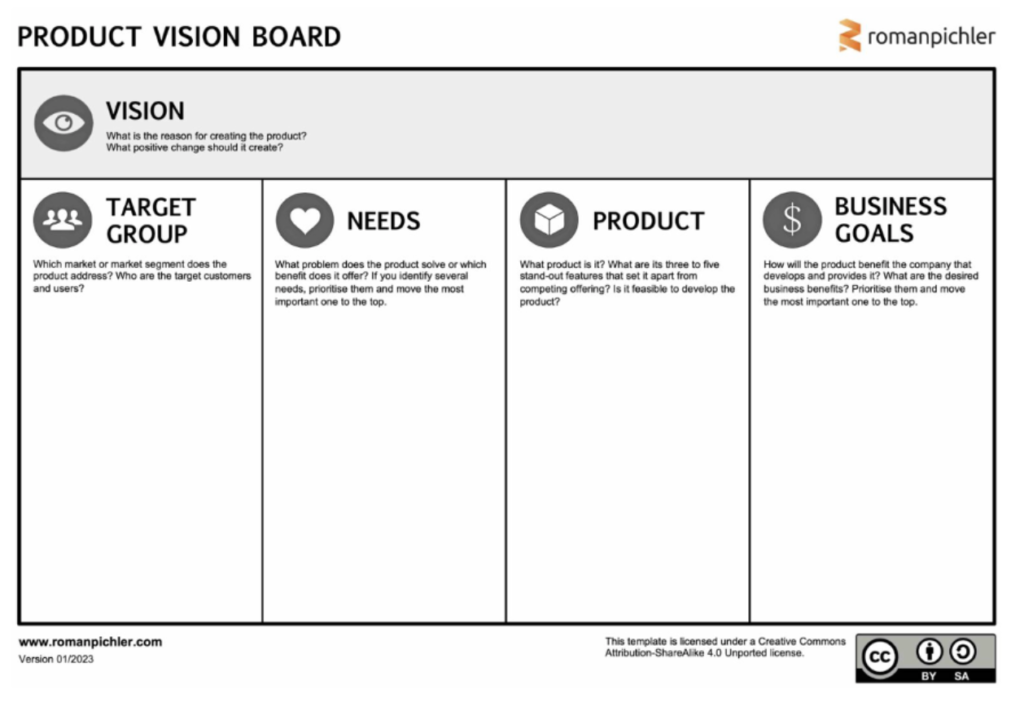
Discussing and reviewing such a product vision board during Board meetings is a very constructive way of getting a holistic view of the product modernisation project and align the Board and the Executive Teams.
Given the overarching nature of the Product Vision Board this approach requires the collaboration of all business functions which is critical. Furthermore, it provides the teams a decision-making framework for the required aspects of all successful product modernisation project. In particular:
- Decide on the right modernisation approach. The typical approaches are refactoring, rebuilding, replatforming or encapsulation. The product strategy will help to decide on the right way forward with important consequences as each approach will have different risk profiles, different resource requirements, timelines and impacts on existing users.
- Decide on team structure and who will lead the project. This can be a difficult one for small-medium sized companies as in many cases they don’t have an established product management team. Working on the product vision board and resulting product strategy will help clarifying the required human resources highlighting any skills gaps and will help establishing the best project leadership structure. A controversial thought but I have experienced that in most cases it is better if the individual who was the leading figure in designing and developing the legacy product is not leading the product modernisation project. This can increase the opportunity to have a fresh perspective when developing the new product.
- Establish the product modernisation roadmap. Only after the product strategy is defined, the modernisation approach chosen, and the product leadership clarified does it make sense to establish a product roadmap. When it comes to product modernisation projects the related data migration plan is often an underestimated component in the roadmap. Gartner estimates that 83% of all data migration projects fail!
- Apply an agile development approach. Executing a well-defined product strategy with an agile development approach allows the teams to test-learn-adjust quickly dramatically increasing the success rate of such a mission critical project.
A product modernisation strategy of small-medium sized software companies needs to be driven as a core business strategy involving all functions starting from the top, not simply an effort driven by the IT function. The consequences of such a well-defined product strategy are profound for executing a successful product modernisation.